Pixel Echo
An illustrated explainer on Pixel Echo: the faint, grid-locked pattern a latent decoder writes into every image, resolved by phase and period and traced back to the decoder.
Ideas, experiments, and discoveries in progress.
An illustrated explainer on Pixel Echo: the faint, grid-locked pattern a latent decoder writes into every image, resolved by phase and period and traced back to the decoder.
 02
A study of diffusion, autoregression, and hybrid generators that operate directly in pixel space without a conventional tokenizer or VAE bottleneck.
ORT generation and AliTok oracle reconstruction share an almost identical P16 fingerprint (ρ=0.996), while PixelDiT remains close to Real. Eight-way single-image attribution rea...
Spatial grouping leaves measurable directional bias. A/B checkerboarding is therefore a testable dependency hypothesis, not an established quality or speed result.
Patch AR reduces repeated hierarchical sampling, but residual objectives still collapse toward parent copying or monochrome texture. An 8-dimensional pixel state makes the first...
Correct L0 stabilizes later levels, yet five levels are 1.69× slower than three in the matched diagnostic without a clear visual gain. GT detail exists; deep levels simply under...
HPA verifies that one causal backbone can generate across resolutions, but triples the sequence work and does not remove coarse errors, parallel DMoL blur, or exposure bias.
Diagonal and column AR predict groups of pixels in parallel, yet the 58k/117k samples show direction-aligned artifacts; ordering becomes a measurable image bias.
RGB-as-tokenizer removes the pretrained tokenizer, but one coarse RGB value maps to many high-resolution patches: mean decoding blurs them, while sampled coarse values propagate...
Pixel-JiT shows that RGB patches can update an autoregressive canvas; v0.16 moves multimodal choice into token CE and renders the selected mode with a one-step decoder.
Testing a latent-AR and pixel-diffusion hybrid, then narrowing the decoder search after pixel-attention experiments produced unstable detail.
A two-stage autoregressive design that separates semantic decisions from pixel regression, together with its context, sampling, and CFG problems.
Reproducing a PixelDiT-style baseline and testing whether a DINOv3 encoder can be fine-tuned into a pixel-space semantic generator.
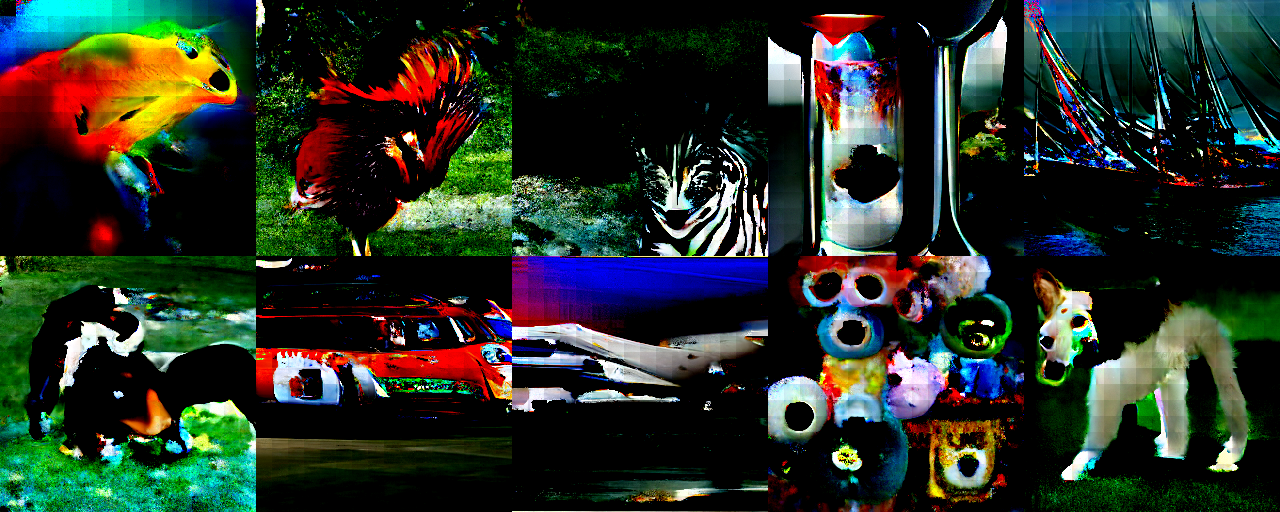
Generated images carry a faint pattern locked to the pixel grid. Measured by phase and period, it points back to the decoder that wrote it.
A high-level look at the mismatch between classification confidence and localization quality, why it breaks NMS, and how ranking objectives might address it.
