
01 / Question
The expensive part is not AR itself, but repeated denoising inside every patch
Pixel-level Generative Models (III) kept a Semantic AR backbone and used diffusion to generate all pixels in a patch jointly. This avoids the semantic conflict of pixel-by-pixel sampling, but introduces a direct compute problem: with N patches and T denoising steps, the pixel head is evaluated N × T times.
Can we preserve patch-level semantic state and RGB history while reducing each patch from a diffusion/flow trajectory to one forward decode?
02 / Pixel-JiT
v0.11.9.3 treats generation as an autoregressive RGB canvas update
The early PAR baseline does not maintain a sequence of discrete tokens. Its state is an RGB canvas containing all previously generated patches. A Semantic AR Transformer reads that canvas and the target location to produce a patch condition h_t. A pixel head generates the current patch, which is immediately written into the next input.
canvas_t → h_t → RGB patch_t → canvas_{t+1}. History and output remain in pixel space; the condition summarizes the global information needed at the current step.
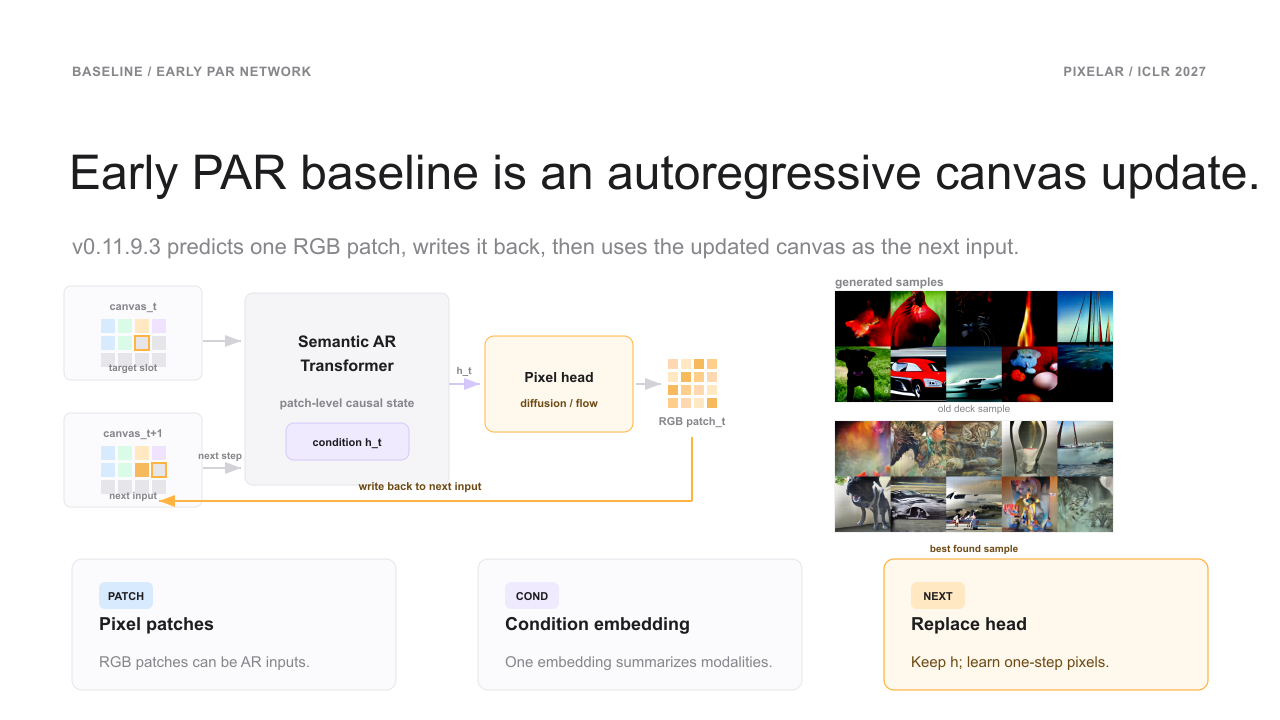
v0.11.9.3 architecture: Semantic AR reads the current RGB canvas, the pixel head generates the next patch, and the result is written back into subsequent context. The architecture slide now sits with the method rather than beside the title.
Free-run samples contain recognizable objects and scenes rather than only local color statistics. This supports two basic claims: RGB patches can act as AR context, and a shared condition embedding can guide the next patch. It does not establish efficiency, because the pixel head still runs a complete denoising trajectory at every position.
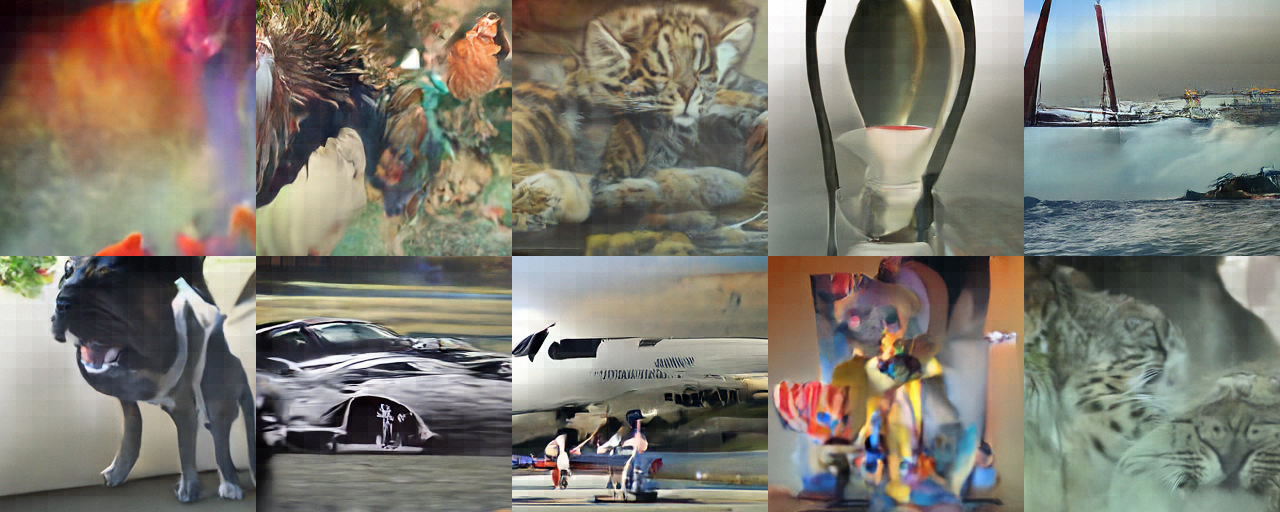
Representative v0.11.9.3 free-run samples. They document feasibility and visible behavior, not an aggregate FID claim.
Parallel Rollout Approximation (PRA), released in June 2026, begins from a closely related problem formulation: a raw RGB patch is both the continuous target at the current step and causal context for later steps, preserving a pixel-in, pixel-out AR interface. PRA then isolates two difficulties that recur throughout our later experiments—high-dimensional single-step patch error and the teacher-forcing train–inference gap.
PRA takes a different route from v0.11.9.3: it predicts low-dimensional intermediate states, decodes them back to RGB, and constructs inference-like feedback with a parallel rollout approximation. It does not validate our exact implementation, but the independent convergence on the problem definition is a useful and encouraging point of contact.
03 / One-step decode
v0.16 separates multimodal choice from pixel rendering
A deterministic decoder operating only on h_t tends to regress toward an average of the conditional distribution. v0.16 therefore adds a token-classification head: first select a mode z_t from a finite codebook, then decode pixels once from z_t and h_t.
The CE head carries the multimodal decision, while the decoder renders a patch conditional on that decision. Relative to Pixel-JiT, this removes the denoising loop and replaces it with one categorical sample and one RGB decode per patch.
| Version | Multimodal choice | Pixel generation | Main limitation |
|---|---|---|---|
| v0.11.9.3 | Diffusion / flow trajectory | Multi-step patch head | Cost grows with N × T |
| v0.16.0 | Token CE | One-step RGB decoder | Still requires a pretrained tokenizer/codebook |
04 / Findings
One-step generation is viable, but the tokenizer becomes the ceiling again
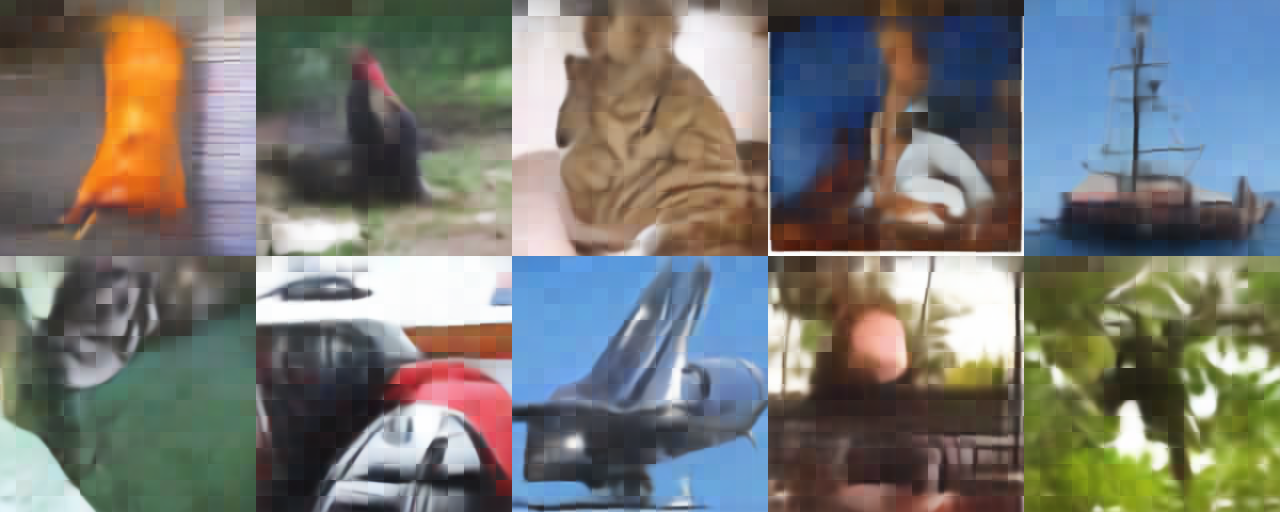
Original v0.16.0 experiment image embedded on slide 9, without slide chrome or annotations: object-level modes are visible, while textures and boundaries retain patchy failures.
- 01
Keep the RGB canvas update
Generated RGB can condition later steps directly; it need not be encoded back into a VQ latent.
- 02
Keep an explicit mode variable
A one-step decoder should not carry the entire multimodal burden. Selecting
z_tfirst avoids pure regression averaging. - 03
Drop per-patch denoising
Pixel-JiT establishes feasibility, but its repeated denoising loop is inconsistent with the efficiency target.
- 04
New bottleneck: the tokenizer
v0.16 has pixel input and output, yet its mode space is still defined by a pretrained codebook, so the detail ceiling remains external.
05 / Open issue
The next step is to replace the codebook, not merely enlarge it
This round does not provide a controlled FID comparison, nor does it prove that v0.16 dominates a diffusion head at matched compute. What it does establish is a structural trade-off: one-step RGB generation needs a multimodal interface, while token CE reintroduces tokenizer dependence.
The next record therefore tests a direct substitute: use low-resolution RGB itself as the coarse “token.” If it can carry both mode and layout, the one-step decoder can remain entirely in pixel space without a pretrained codebook.
