01 / Research question
What changes when we remove the latent bottleneck?
Most image generators first compress images into a latent space and then model the compressed representation. This approach is efficient, but the tokenizer or VAE determines which details are retained and which are discarded before generation begins.
PixelGen asks a direct question: if the final target is always an image, can the model operate in pixel space from input to output? Beyond feasibility, we want to understand how pixel-space modeling changes representation learning, computational cost, and the design of diffusion and autoregressive generators.
If direct pixel modeling preserves useful visual information, the benefit should not depend on one specific backbone. It should be usable by diffusion, autoregression, and hybrid architectures.
02 / Approach
Four architecture branches
Pixel Diffusion
Reproduce a PixelDiT-style baseline and test whether REPA and DINOv3 noisy-input fine-tuning improve pixel generation.
Baseline establishedDual-level AR
Generate a global semantic proposal first, then sample pixels within each patch. Multimodal modeling is separated into semantic and pixel levels.
Initial validation completeLatent AR + Pixel Diff
Use AR for global structure and diffusion to process local pixels jointly, reducing conflicts caused by sequential pixel sampling.
Stage validation completeHierarchical Pixel AR
Share one Transformer across RGB scales, then isolate coarse history, local residuals, and phase-parallel patch dependencies.
Current experiment line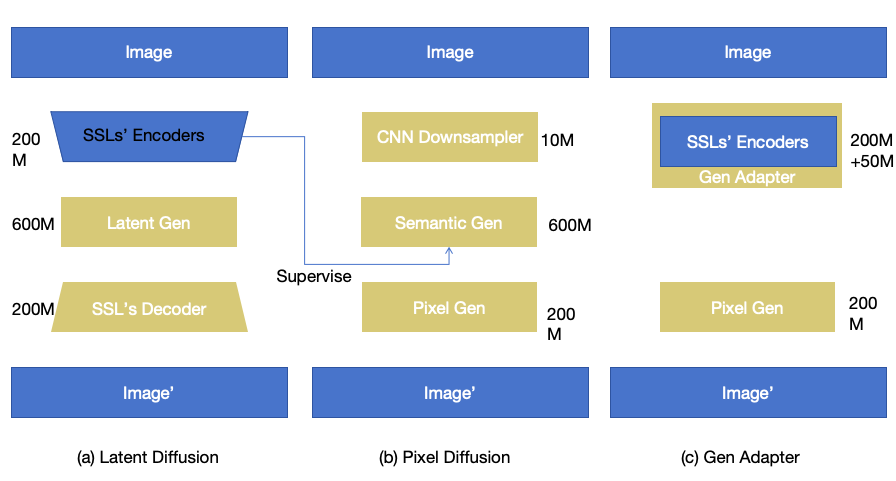
Three routes into the same question: a latent pipeline, a direct pixel pipeline, and a perceptual model adapted to noisy pixel inputs.
03 / Results
Generation results
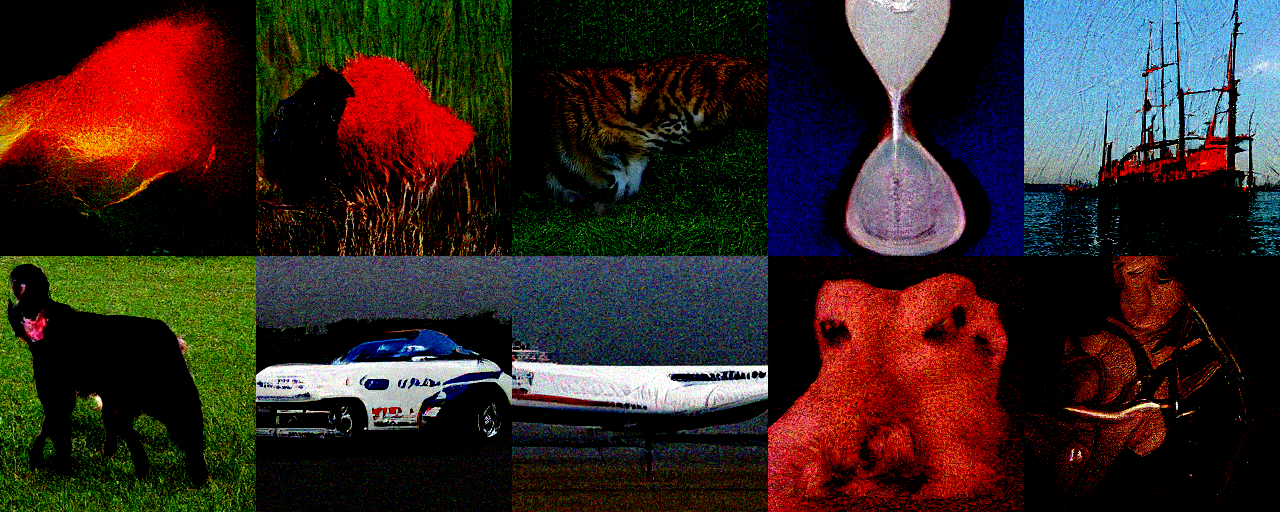
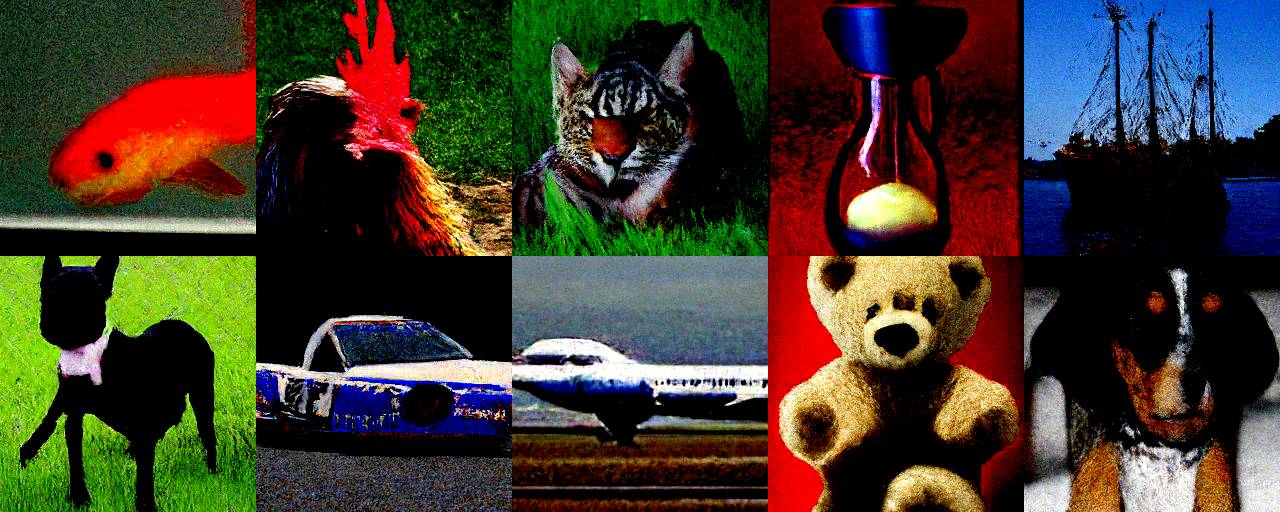
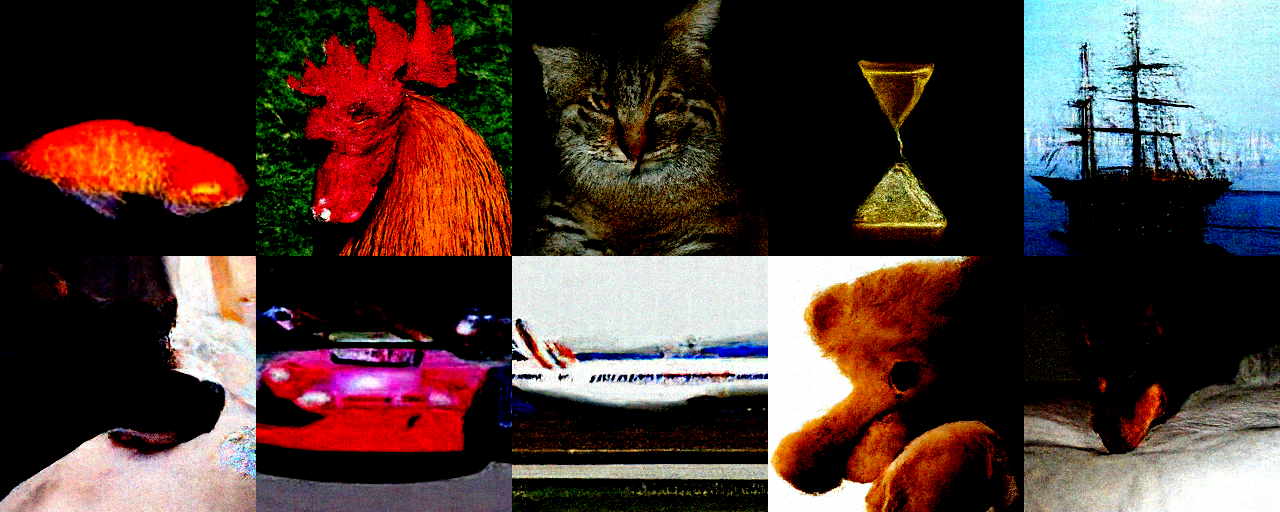
Qualitative comparisons under a consistent training setup.

04 / Current findings
Current findings
These statements reflect the available evidence and will be updated as experiments continue.
- 01
Direct pixel generation trains reliably
A PixelDiT-style baseline trains stably and produces coherent semantic structure without elaborate tricks. The main question has moved from feasibility to quality and efficiency.
- 02
Low-resolution RGB is useful but not an invertible mode index
It carries color, layout, and identity, but under the tested interfaces and capacities it does not recover high-frequency detail reliably, while sampled history propagates coarse errors downstream.
- 03
Spatial generation order leaves directional bias
Diagonal and column grouped AR produce different period-32 statistics, showing that factorization changes the error structure. This remains a cohort diagnosis, not a per-image watermark claim.
- 04
Hierarchical failure begins in coarse history, while fine residuals are under-produced
GT forcing localizes the main drift to L0 / sampled history. Fine-level residuals are also much smaller than true adjacent-scale differences, so extra levels do not automatically add detail.
- 05
Loss reweighting cannot replace explicit dependence between pixels
The v0.17.9 hard-detail loss degenerates into high-frequency templates, while the first compact-CA model produces noise because its pixel state and readout are too weak, returning the mainline to local Pixel AR.
- 06
Phase-parallel is the next testable hypothesis
v0.19.1 contains a checkerboard A/B code path but no training result. Quality, speed, boundaries, and rolling KV require small-model controls before any conclusion.
- 07
Decoder fingerprints are an auxiliary diagnosis, not the generator mainline
Generation and reconstruction through the shared AliTok decoder show a highly correlated P16 cohort pattern, indicating that a decoder can add RGB distribution shift. Detection and attribution remain separate from the current architecture decision.
05 / Progress
Project progress
The baseline, architecture changes, and key decisions.
-
Reproduced a PixelDiT-style baseline
Built a trainable baseline with a one-layer 1D convolution, standard Transformer blocks, and a lightweight pixel diffusion head.
Decision Keep this implementation as the common baseline for subsequent branches.
Read original note -
Used DINOv3-S for noisy pixel inputs
REPA alignment improves faster, but the final generation quality changes only slightly, exposing a gap between semantic and pixel objectives.
Decision Do not scale the DINO path as the primary architecture.
Read original note -
Designed a dual-level autoregressive generator
Separated multimodal semantic sampling from local pixel sampling and analyzed context length, dictionaries, and the role of CFG.
Decision Move to a diffusion decoder that processes all pixels within a patch jointly.
Read original note -
Moved to latent AR with pixel diffusion
Semantic AR supplies global structure while pixel diffusion generates local pixels jointly, reducing conflicts introduced by sequential sampling.
Decision Continue searching for a lightweight alternative to full pixel attention.
Read original note -
Moved from one-step RGB decoding to multiscale RGB
The one-step decoder establishes the Pixel-JiT path; low-resolution RGB and CascadeAR then expose latent ambiguity and sampled-history drift.
Decision Stop asking one coarse RGB value to explain a full patch; measure value, belief, and history separately.
Read original note -
Compared diagonal and column orders for full-image pixels
Both grouped AR variants form images but produce different directional periodic bias, confirming that spatial order is part of the modeling assumption.
Decision Report group boundaries and directional statistics for subsequent dependency designs.
Read original note -
Validated shared HPA and localized hierarchical errors
One shared Transformer trains and samples across levels. GT forcing traces the main drift to L0/history, while fine levels under-produce true residuals.
Decision Repair history dependence and local-detail modeling before adding more levels.
Read original note -
Concentrated stochastic mode selection in one Patch AR
Residual DMoL, hard-detail loss, and compact cross-attention show that loss weighting cannot replace explicit spatial dependence.
Decision Retain one patch-level stochastic choice and introduce local AR inside each patch.
Read original note -
Defined Phase-Parallel Pixel AR as an unvalidated hypothesis
A/B checkerboarding lets 128 same-phase patches advance each pixel step together. v0.19.1 currently provides code, not training evidence.
Decision Validate cached parity, phase communication, the sampling gap, and rolling KV on [1,2,4] before a full five-level model.
Read original note -
Localized the latent-decoder lattice shift in RGB output
Across 8×1,000 images, ORT and AliTok reconstruction share a P16 fingerprint; PixelDiT remains close to Real, while decoder families show different P2–P16 responses.
Decision Retain the multiscale fingerprint as auxiliary evidence without letting the detection task replace generator validation.
Read original note -
Returned to minimal validation of Phase-Parallel Pixel AR
The existing records separate the problem into coarse mode selection, sampled history, local dependence, and spatial order. The next experiment must control them within one small hierarchy.
Decision Complete [1,2,4] ablations for correctness, conditioning, phase factorization, and KV eviction before investing in five-level training.
Read original note
