01 / Ordering diagnosis
Spatial generation order leaves a directional fingerprint across a sample cohort
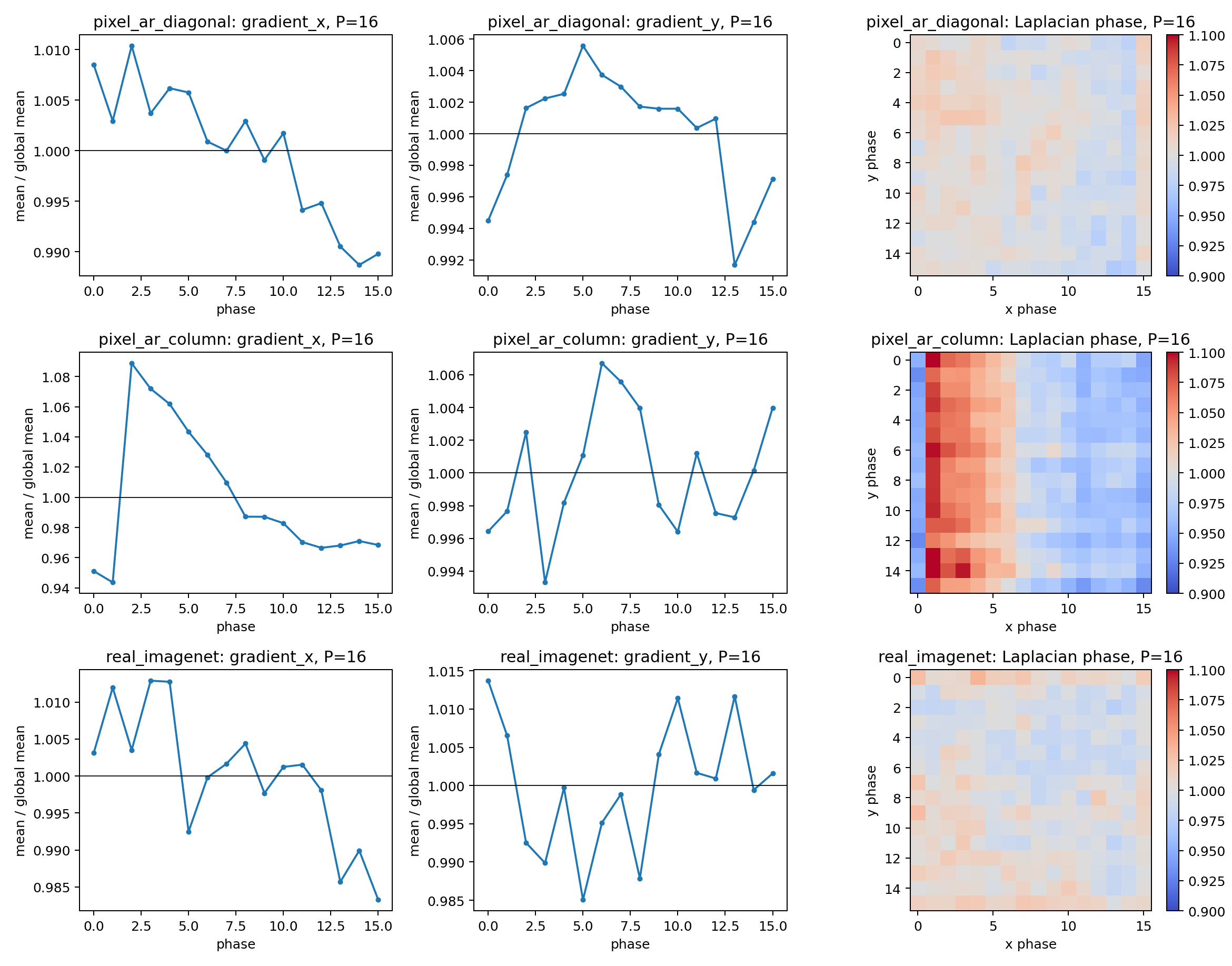
Rather than flattening an image into an arbitrary sequence, v0.18.x compares diagonal and column groups. v0.18.1 leaves actual diagonal samples at about 58k steps; v0.18.2 leaves column samples around 117k / 110k. Both produce image structure, but their periodic patterns differ.
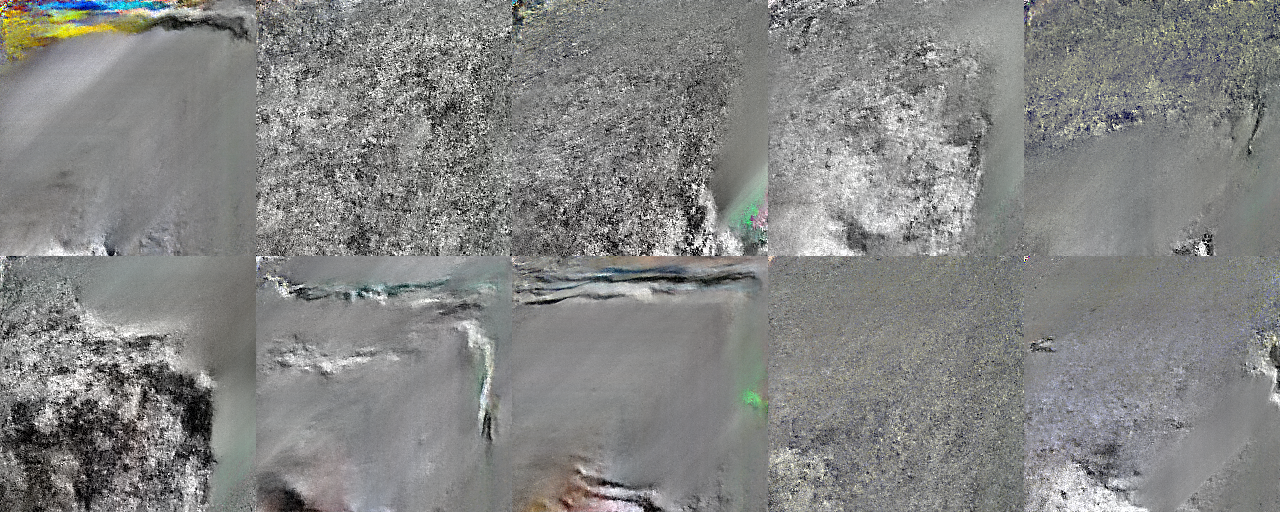
v0.18.1 · diagonal groups · step 58k. Global structure forms, while group boundaries can still surface in local texture.
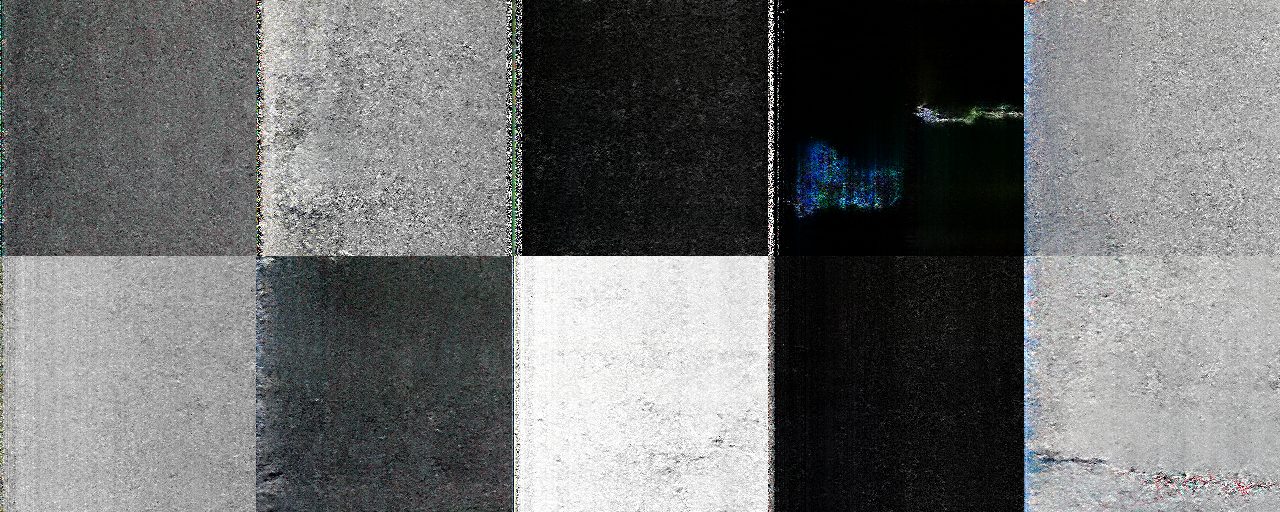
v0.18.2 · column groups · step 117k. Changing the spatial organization changes where errors accumulate.
For period-32 horizontal-gradient statistics, phase variation is about 30.2% in the column cohort and 5.6% in the diagonal cohort. This supports the claim that grouping direction changes aggregate bias. It does not show that every column sample has the same 32-pixel watermark, nor does comparison of unmatched checkpoints rank one order above the other.
Spatial factorization is not merely an implementation detail. Which positions communicate first and which positions run in parallel changes the direction and period of visible errors.
02 / Prototype
v0.19.1 implements a minimal checkerboard A/B path, but provides no result
v0.19.1 divides a 256×256 image into 256 macro patches of 16×16 pixels and partitions them into checkerboard A/B phases. The 128 patches inside one phase share each pixel step, while every patch retains strict raster-order Pixel AR; Phase B may read the generated Phase A.
| Component | Current state | What it establishes |
|---|---|---|
[1,16] coarse-to-patch hierarchy | Implemented | The tensor path and two-scale interface exist |
| A/B checkerboard + 128-patch batching | Implemented | A code path for within-phase parallelism exists |
Local 16×16 Pixel AR + KV cache | Implemented | The patch-local causal generator exists |
| Training checkpoint / log / sample | Not found | No claim about quality, speed, or boundary continuity |
v0.19.1 is therefore a proof-of-concept implementation, not proof of effectiveness. It advances the question from “can this graph be expressed?” to “is this factorization worth training?”
03 / Multilevel Phase Schedule
The same image gains resolution from L0 to L4: global AR at L0, then batched A/B phases
The interactive figure exposes the five spatial levels of the full design. L0-L4 render the same image at 16², 32², 64², 128², and 256², corresponding to 1², 2², 4², 8², and 16² RGB pixels inside each macro patch. L0 retains a conventional raster-order scan over 256 coarse RGB tokens. Only L1-L4 split the 256 patches into A/B groups and advance 128 patches at a time. This visualizes the proposed full Phase-Parallel HPA schedule; it does not claim that v0.19.1 already implements five-level training.
L0 · Global AR
L0 is a conventional 256-step global autoregressive scan. L1-L4 retain the same image while each level uses two batched A/B phase views; selecting a stage pauses autoplay so it can be inspected.
One image, refined in place: each phase overwrites only its checkerboard half
This second view removes the duplicate A/B canvases and follows one persistent image. After L0 finishes, L1A changes only A while B remains at L0 resolution; L1B then replaces the remaining B pixels. The completed L1 image becomes the base for L2, and the same process continues through L4.
L0 · Global AR
The canvas never resets between levels. A replaces only its checkerboard half; B then replaces the remaining half. The next level starts from that completed image.
v0.19.1 implements two-stage checkerboarding and patch batching, but remains a two-level [1,16] model. Phase communication uses a separate bidirectional context layer, and Pixel AR receives one 64-dimensional prefix rather than the shared Phase AR, rolling KV, or AdaLN proposed below.
04 / Full hypothesis
Replace fully serial Patch AR with cross-level, cross-phase, and within-patch dependencies
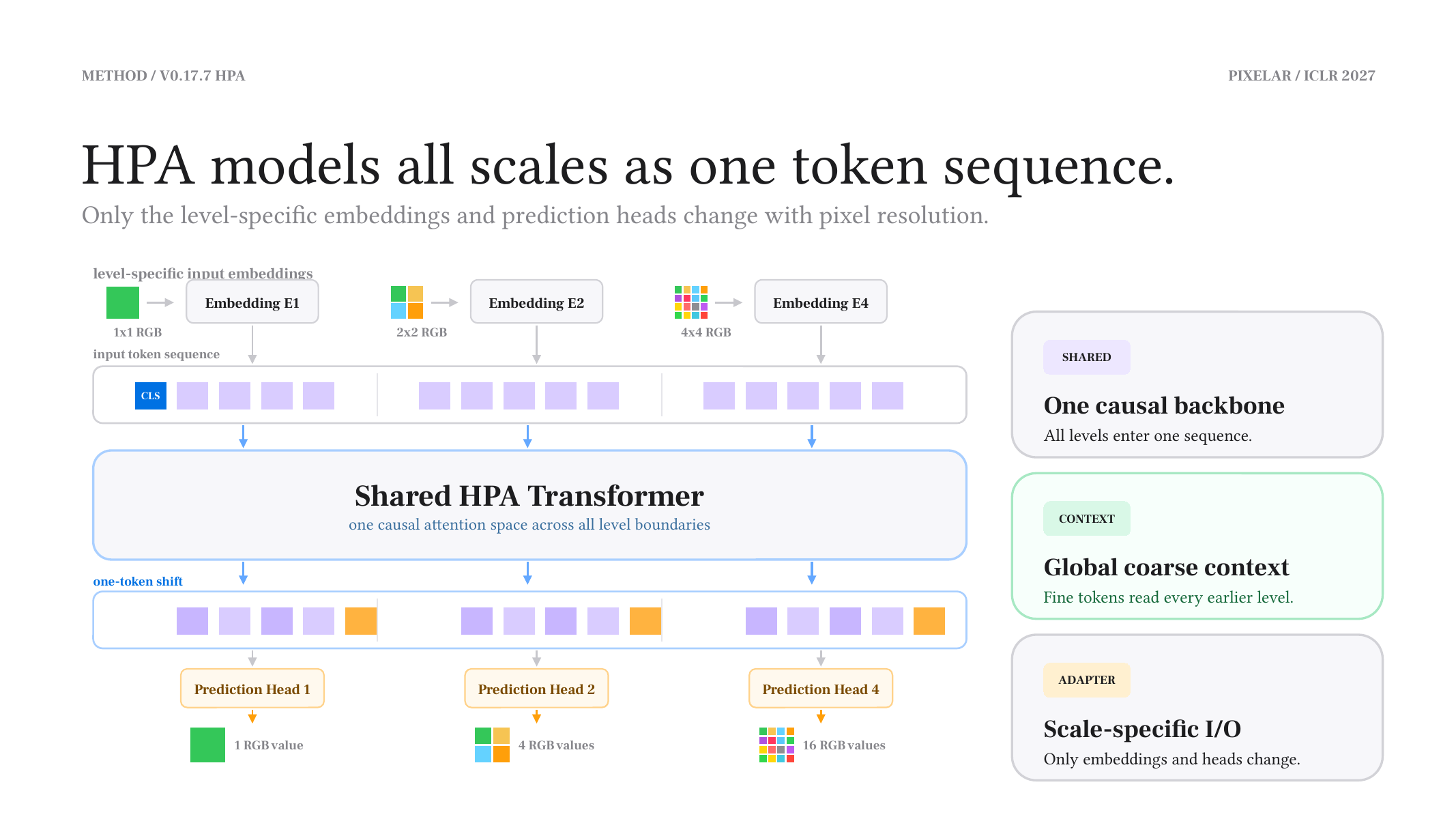
v0.17.7 establishes that one shared causal Transformer can train and sample across RGB levels. The proposal only replaces each level's total patch order with a two-phase partial order.
Coarse AR
The 256 coarse RGB values at L0 remain globally autoregressive and carry semantics and layout.
Retain the HPA trunkPhase AR
L1-L4 generate A before B; one large shared Transformer carries state across levels and phases.
Two-stage partial orderPatch RGB AR
The 128 patches in a phase advance the current pixel together, while each patch preserves raster causality.
Strict local ARThe full five-level proposal needs 2(4+16+64+256)=680 synchronized local Pixel AR rounds. Adding 256 L0 rounds and eight phase transitions gives a dependency path of roughly 944. This describes the computational graph, not a measured speedup.
The condition interface would also grow from a single 64-dimensional prefix to layer-wise modulation: parent RGB, pixel position, level, and phase jointly generate AdaLN parameters. Shared-Transformer KV states would roll across phases so memory and retained history become an explicit, measurable trade-off.
05 / Unknowns
Five questions must be isolated before the design is credible
- 01
Is within-phase conditional independence too strong?
Checkerboarding prevents same-phase patches from sharing horizontal or vertical edges, but does not guarantee consistent color, texture, or long-range structure.
- 02
Does A→B communication help?
A no-A→B control is required to separate the checkerboard partition from the value of phase communication.
- 03
Where does the teacher-forcing gap begin?
Sampled parent, sampled Phase A, and sampled pixel history must be substituted separately rather than collapsed into one free run.
- 04
Does AdaLN use its condition?
Correct, shuffled, and zero conditions should create interpretable NLL differences; training loss alone cannot establish this.
- 05
When should rolling KV be evicted?
Pre-eviction, post-eviction, and full history must be compared on quality, memory, and phase latency.
06 / Validation plan
Prove equivalence and causality before training the full five-level model
| Stage | Control | Pass condition |
|---|---|---|
| Correctness | cached / uncached; one patch / 128-patch batch | Teacher-forcing logits and sampled sequences align exactly |
| Condition interface | prefix / AdaLN; correct / shuffled / zero | Establish condition sensitivity, not only low training loss |
| Phase factorization | serial / A-B / no A→B | Report Phase A/B NLL, seams, and measured latency |
| Sampling gap | GT / sampled parent; GT / sampled Phase A | Separate cross-level, cross-phase, and within-patch errors |
| Rolling KV | full / pre / post eviction | Record quality, peak memory, and phase latency together |
| Scale-up | [1,2,4] → five levels | Expand only after the small model validates communication |
We have evidence that spatial ordering creates directional bias and that a phase-parallel path can be implemented. We do not yet have evidence that it improves quality, speed, or patch-boundary continuity.
