01 / Ordering
Choosing which pixels run in parallel also chooses which pixels cannot condition on one another
A fully rasterized 256×256 Pixel AR model requires 65,536 sequential steps. v0.18.x removes patchify and predicts one spatial group at a time: pixels inside a group emit DMoL parameters in parallel, while groups remain autoregressive.
| Version | One token represents | Sequential rounds | Missing within-group dependency |
|---|---|---|---|
| v0.18.1 | One complete image diagonal | About 511 | Pixels on the same diagonal |
| v0.18.2 | One column of 256 pixels | 256 | Vertical pixels in the same column |
| v0.18.3 | 16×16 raster L0 → 32-column L1 | Hierarchical | Implemented, but no complete result is visible locally |
Larger groups reduce sequential depth, but strengthen conditional independence within a group and make the generation direction more likely to become image texture.
02 / Results
Neither diagonal nor column grouping organizes parallel pixels into stable semantics
Local v0.18.1 samples at roughly 58k steps remain dominated by noisy structure. At roughly 117k steps, v0.18.2 forms larger color regions, but also shows left-to-right propagation, vertical bands, and periodic repetition. A v0.18.2 temperature sweep did not convert these patterns into stable ImageNet semantics.
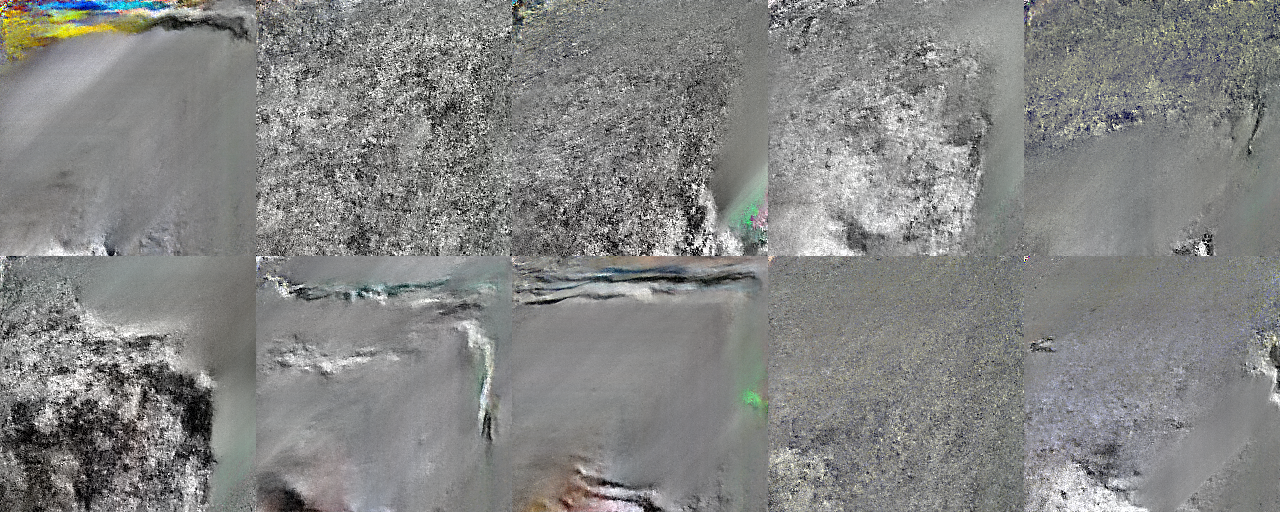
v0.18.1 at 58k steps. Diagonal grouping lowers sequential depth, while samples remain primarily directional noise and weak structure.
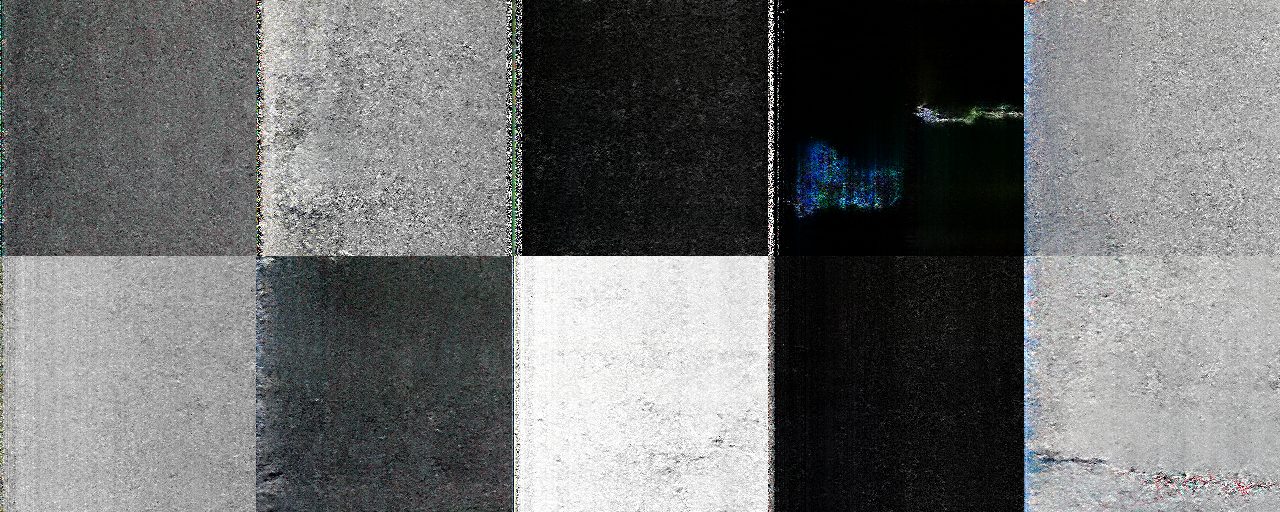
v0.18.2 at 117k steps. Sampling a full column at once produces bands and propagation traces aligned with left-to-right generation.
03 / Periodicity
Convert “it looks striped” into a comparable phase-variation statistic
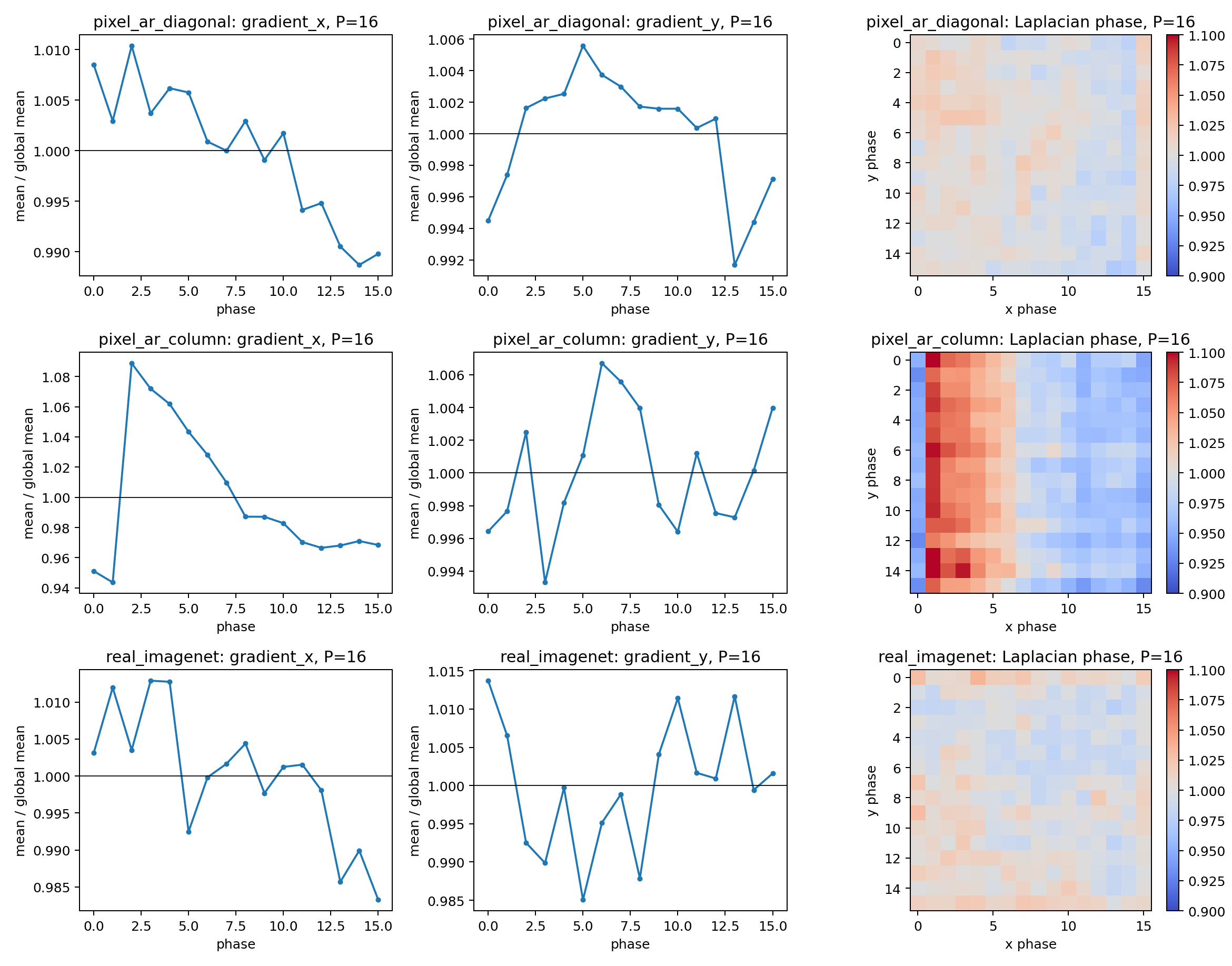
To avoid relying on selected images, we compute gradient and Laplacian phase profiles for 100 images at spatial periods P ∈ {2,4,8,16,32}. For each period, the range of phase means is normalized by the global mean:
At period 32 for horizontal gradients, the column model has A₃₂ ≈ 0.302, compared with about 0.056 for the diagonal model. This agrees with the visible column bands: column grouping imprints a substantially stronger horizontal phase bias into the generated cohort.
Diagonal
P32 gradient-x phase variation is about 5.6%.
Weaker but still significant directional biasColumn
P32 gradient-x phase variation is about 30.2%.
Column propagation leaves strong periodic structureImageNet
The same statistic is computed on natural images.
Model phase is not treated as a per-image watermark04 / Boundaries
This is a distribution-level bias, not a recovered watermark in every image
- 01
Established: ordering changes artifact direction
Diagonal and column samples have different directional biases in both images and phase profiles.
- 02
Established: fewer rounds do not imply better generation
Column AR needs only 256 rounds, but missing within-column dependencies create a new structural gap.
- 03
Unsupported: every image contains a detectable watermark
The analysis supports a cohort-level distribution effect; it does not recover an exact RGB template per image.
- 04
Unverified: v0.18.3 fixes the problem
Raster L0 plus column L1 has model code, config, and scripts, but no complete local training artifact.
05 / Next step
The model needs hierarchical context and finer communication between groups
Pure diagonal and column models turn an efficiency problem into a spatial-dependency problem. The next stage no longer asks one global ordering to carry both semantics and detail. It returns to a multiresolution hierarchy: coarse levels establish the global mode, fine levels add density, and cross-level experiments determine how sampled values and hidden belief should be passed forward.
