01 / 研究问题
问题不只是重建误差,而是 decoder 是否改写了像素分布
Latent generator 的最后一步必须把低维 token 或 feature map 还原为 RGB。若 decoder 以固定 patch、unpatchify 或多级上采样输出像素,它可能在训练数据中不存在的空间周期上重复同一组滤波响应。这个效应即使不形成肉眼可见的方块,也可能改变梯度与高频能量在像素相位上的分布。
因此,我们不先比较 FID,也不训练一个新的 detector,而是问三个更基础的问题:这种格点偏移是否存在;能否定位到 decoder;一张图是否已经包含足够的统计信息来检测或归因来源?
02 / 数据与方法
同一套像素统计覆盖直接生成、latent 生成与五种 reconstruction
| Cohort | 角色 | 采样与配对 |
|---|---|---|
| Real ImageNet[1] | 自然图像 control | 随机 1,000 张,覆盖 650 classes |
| PixelDiT[2] | 直接 pixel-space generation | 1,000 classes 各一张,independent |
| ORT[3] | latent AR + AliTok[4] decoder | 1,000 classes 各一张,independent |
| AliTok[4] / Cosmos[5] / SD VAE[6] / SDXL[7] / RAE[8] | oracle reconstruction controls | 与 Real 使用同一 1,000 个 source images,逐图配对 |
每张 256×256 图像先计算 absolute Laplacian energy。对周期 P,把坐标按 (u mod P, v mod P) 分组并除以图像全局均值,得到每图 normalized phase map MP:
WP 只是把 cohort-level expected phase-energy bias 铺回像素坐标,便于观察重复结构;它不是从单张图恢复出的精确 RGB watermark。单图主特征为 f(x)=vec[M₂,M₄,M₈,M₁₆],共 340 维;P32 只用于 robustness。
这一定义与 Neighboring Pixel Relationships(NPR)[10] 有直接但不等价的联系。NPR 中的 2×2 来自常见的 l=2 upsampling scale / stride,而不是后续 convolution 的 3×3 kernel;它在固定、非重叠的 2×2 blocks 内计算局部 RGB reference difference。相比之下,MP 聚合整幅图像的 modulo-P absolute-Laplacian phase energy,不保留 NPR 的逐 block RGB 相对值。
两者仍共享一个方法风险:固定 block origin 或坐标原点会保留 absolute grid phase。因此,把 P2/P4/P8/P16 直接 concatenation 可能形成一种 multi-scale NPR-like phase cue,而不代表四种独立机制。这个风险尚未由当前实验确认;cyclic shift、random grid origin、phase-marginalized feature 与显式 NPR baseline 都属于待完成的 phase-origin controls。
统计协议使用 deterministic 五折 grouped CV:Real 与五组 reconstruction 的同一 source 永远在同一 fold;PixelDiT 与 ORT 按 1,000 个 class 分到五折。每折的 scaler、centroid 与 OAS covariance 只在训练折拟合,最终汇总完整 out-of-fold predictions。
03 / 因果定位
ORT 与 AliTok reconstruction 共享同一个 P16 指纹
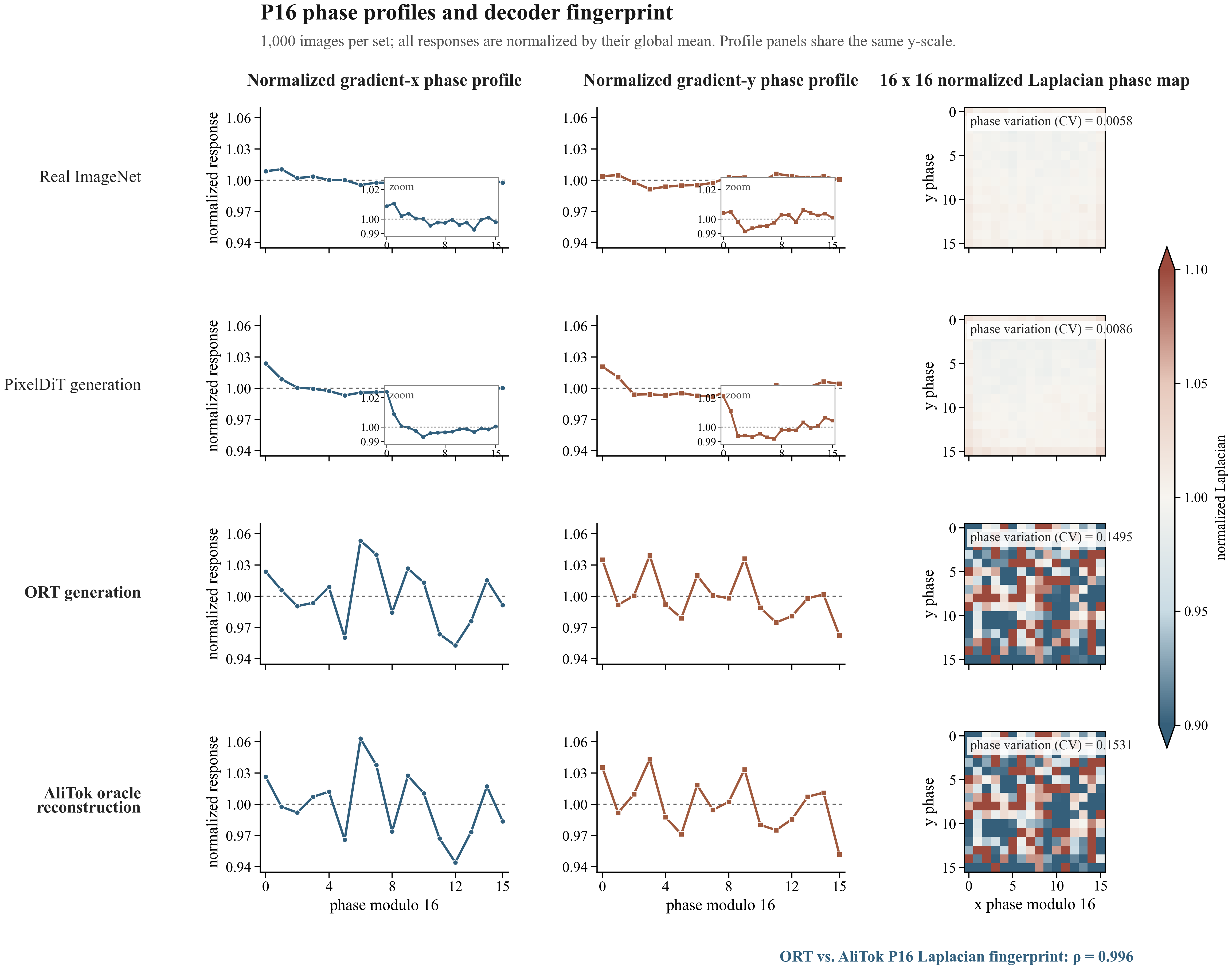
每组 1,000 张图。四行依次为 Real、PixelDiT、ORT generation 与 AliTok oracle reconstruction;所有 heatmap 使用相同的 0.90–1.10 normalized scale。
| Cohort | P16 Laplacian phase variation | 相对 Real |
|---|---|---|
| Real ImageNet | 0.0058 | control |
| PixelDiT | 0.0086 | 仍为弱 modulation |
| ORT | 0.1495 | 强 P16 lattice |
| AliTok reconstruction | 0.1531 | 强 P16 lattice |
更关键的是,ORT 与 AliTok reconstruction 的完整 P16 Laplacian fingerprint 相关系数为 ρ=0.996。两组图像的语义来源不同:一组是 latent AR generation,另一组是 Real ImageNet 的 oracle reconstruction;它们共享的关键组件是 AliTok decoder。这个对照把强 P16 pattern 从“ORT 生成器整体”进一步定位到共享 decoder 的输出机制。
现有证据强烈支持 AliTok decoder 是 ORT P16 fingerprint 的直接来源。它不支持“所有 patch embedding 都必然产生同样偏移”:PixelDiT 内部同样使用 patch representations,但没有经过独立 image decoder,统计上仍接近 Real。
04 / Decoder 家族
不同输出机制在 P2、P4、P8 与 P16 上留下不同 lattice response
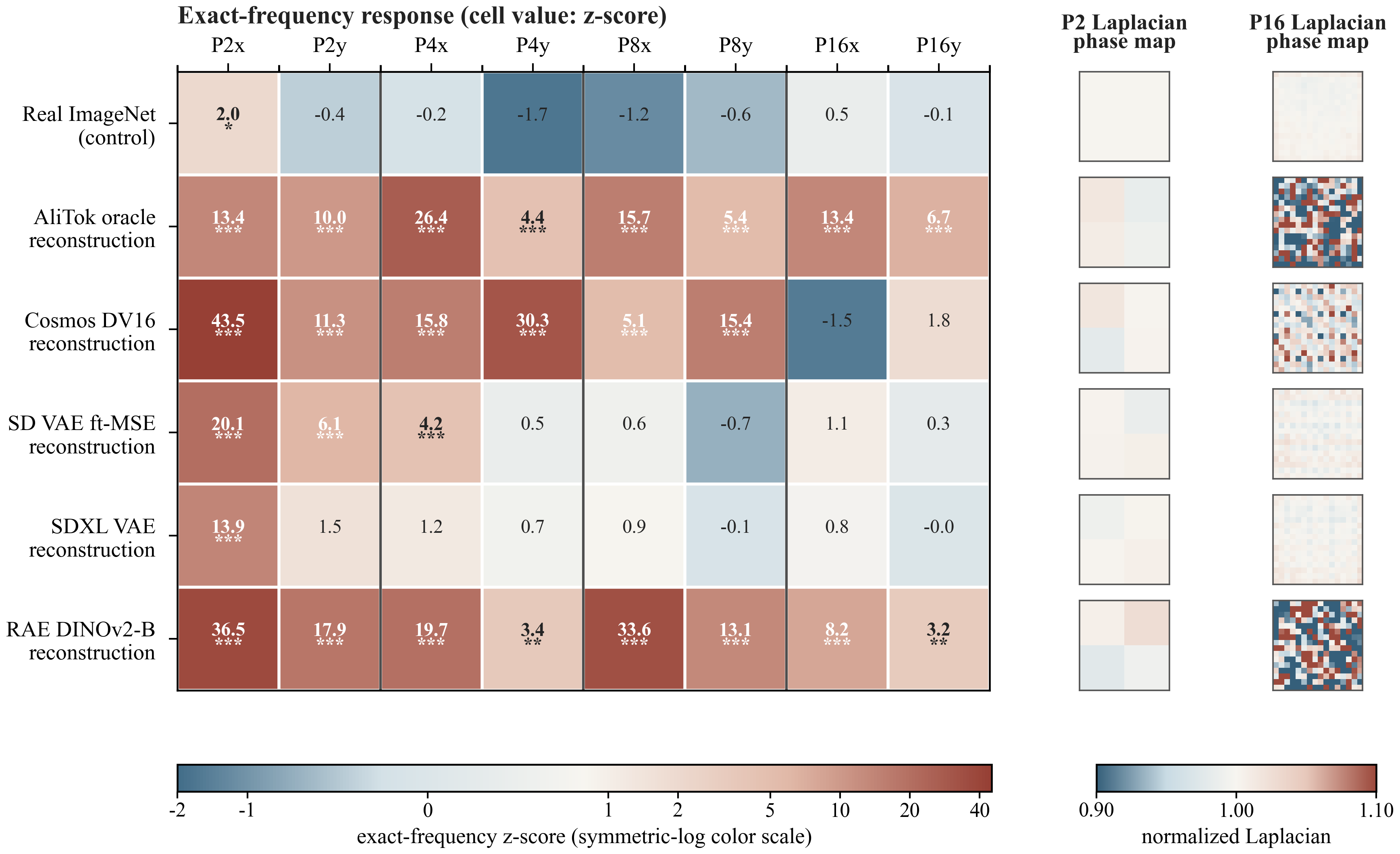
Exact-frequency z-score 来自 random-phase permutation null;格内星号为 raw permutation significance。主统计结论另以 28 组 planned tests 的 Holm correction 加固。
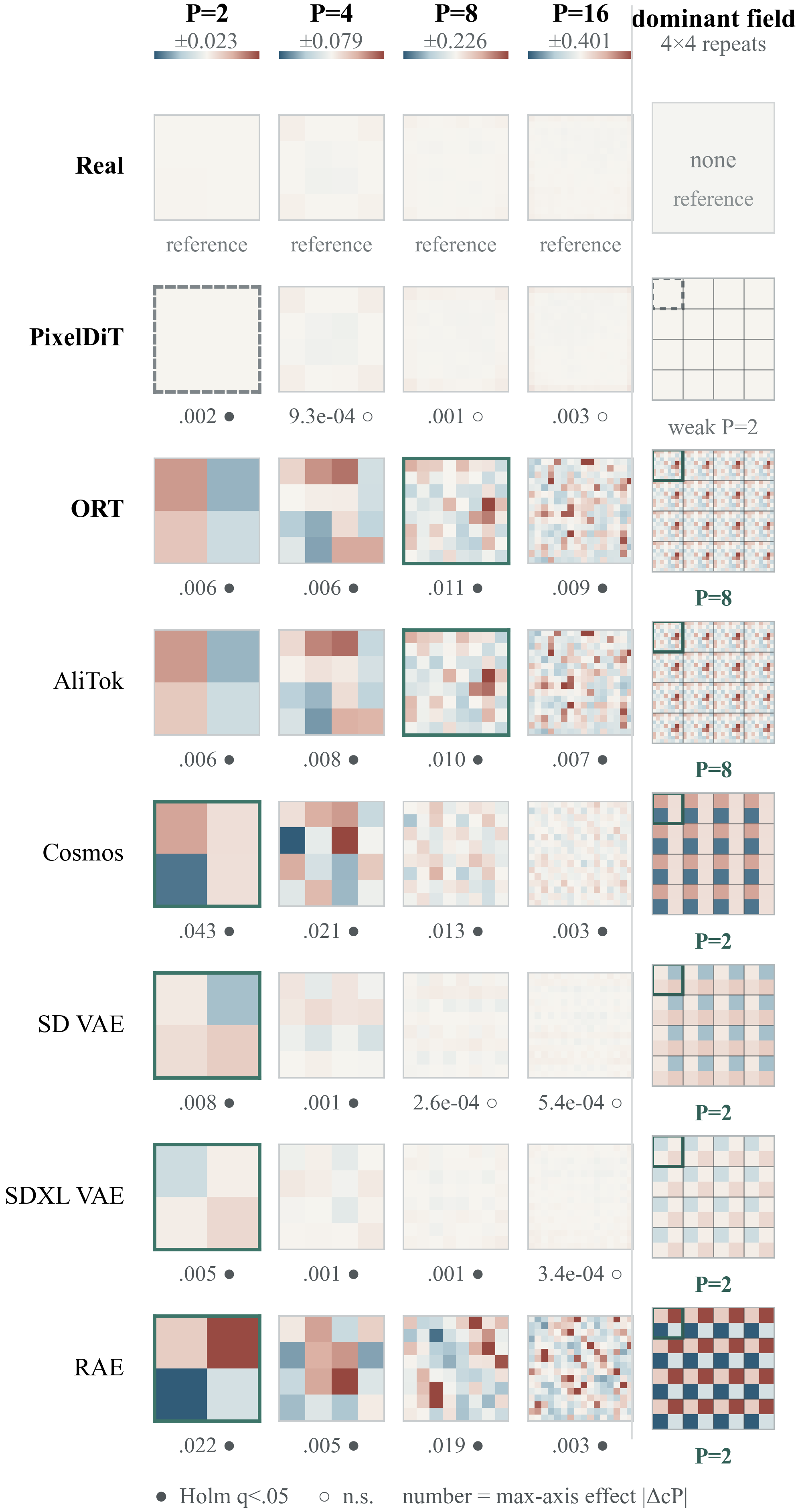
多尺度 normalized Laplacian phase maps。每行单独标出 dominant period;实心圆表示 Holm-corrected q<.05。各列使用自己的共享色标,避免把小尺度的弱响应视觉放大。
| Decoder | 输出机制 | 观测到的频率结构 |
|---|---|---|
| AliTok[4] / ORT[3] | Transformer,单 projection 输出 16×16×3 后 rearrange | P4、P8、P16 均有稳定响应,P16 pattern 共享 |
| Cosmos DV16[5] | causal convolutional ResNet + repeat-interleave upsampling + UnPatcher | P2/P4/P8 强,P16 较弱 |
| SD VAE ft-MSE[6] | 2D convolutional ResNet + 多级 2× upsampling | 主要集中在 P2,P16 不显著 |
| SDXL VAE[7] | 与 SD VAE 同属 AutoencoderKL / UpDecoderBlock2D | 总体更弱,可靠信息集中在 P2/P4/P8 |
| RAE[8] DINOv2-B[9] | ViT-MAE Transformer patch-output + unpatchify | P2/P4/P8 强,P16 仍有显著但不同的 pattern |
因此 fingerprint 不是一个固定的“P16 检测器”。更准确的表述是:decoder 的输出与上采样结构给出候选周期,训练后的 filters、objective 与数据决定响应幅度。
05 / 分布偏移
PixelDiT 与 Real 几乎重合,decoder cohorts 形成不同距离层级
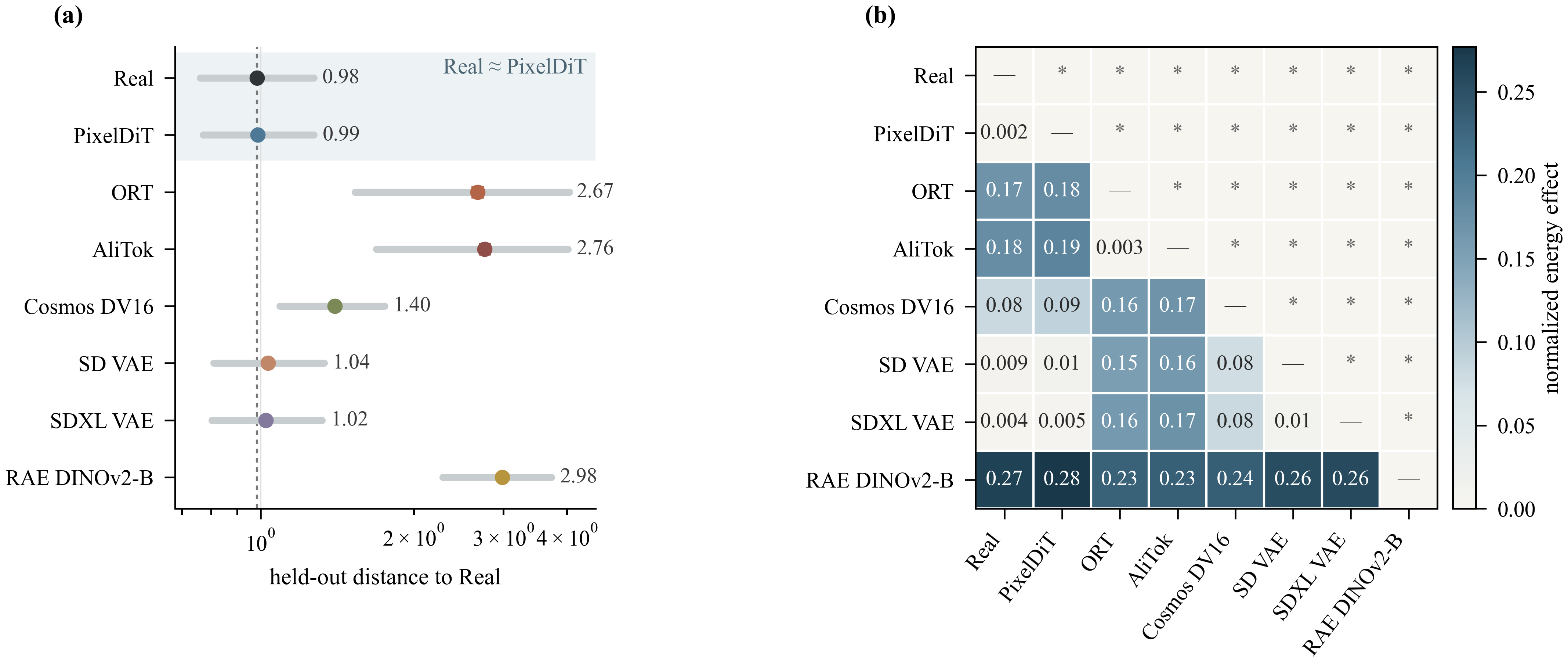
左:fold-local held-out distance-to-Real 与 grouped-bootstrap interval。右:pairwise normalized energy effect;上三角星号表示 28 组 planned pairwise tests 经 Holm correction 后显著。
| Cohort | Mean distance-to-Real | Normalized energy effect vs Real | Holm-corrected test |
|---|---|---|---|
| Real | 0.984 | — | control |
| PixelDiT | 0.988 | 0.0018 | distance q=.738; energy q=.028 |
| SDXL VAE | 1.025 | 0.0035 | q=.007 / .028 |
| SD VAE | 1.035 | 0.0094 | q=.007 / .028 |
| Cosmos DV16 | 1.399 | 0.0815 | q=.007 / .028 |
| ORT | 2.668 | 0.1679 | q=.007 / .028 |
| AliTok | 2.757 | 0.1778 | q=.007 / .028 |
| RAE DINOv2-B | 2.984 | 0.2661 | q=.007 / .028 |
1,000 张图带来很高的统计功效,所以 Real–PixelDiT 的极小 energy effect 也能达到 q=.028。这里应优先看 effect size,而不是只看星号:PixelDiT 的 0.0018 与 ORT/AliTok 的 0.168/0.178 相差近两个数量级。
06 / 单图检测与归因
一张图已足以检测多数 decoder,但共享 decoder 的 generator 很难彼此区分
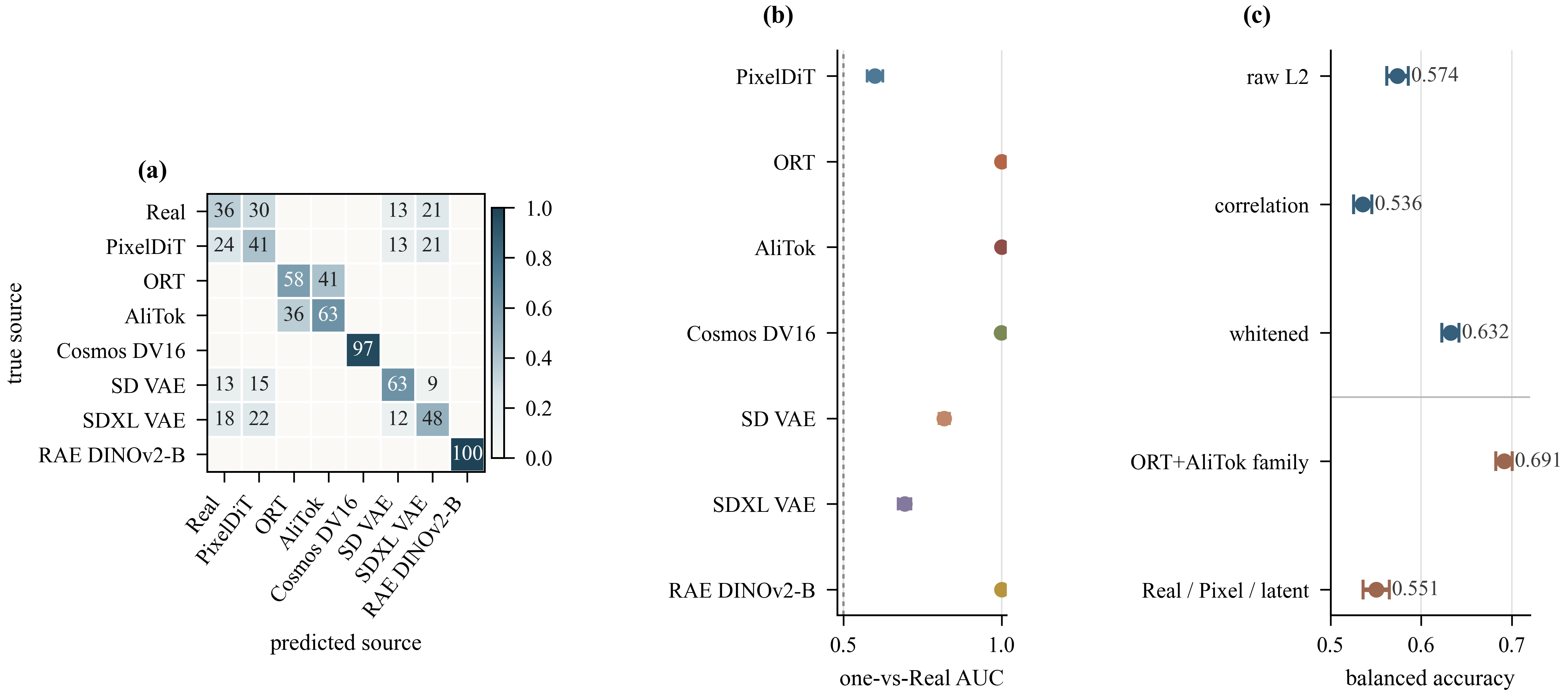
所有数值均为五折 out-of-fold 结果。误差线为 95% grouped-bootstrap interval;同一 source 的 Real/reconstruction pair 在 bootstrap 中保持绑定。
8-way balanced accuracy
Whitened nearest-centroid,95% CI 62.3–64.2%。
随机猜测为 12.5%Macro-F1
八个 source 的 precision / recall 得到较均衡的汇总。
完整 OOF predictionsShared-decoder 7-way
把 ORT 与 AliTok 合并为同一 decoder family 后的 balanced accuracy。
95% CI 68.2–70.0%八分类 balanced accuracy 是八个 source recall 的平均值,不是“模型对某张图有 63.2% 置信度”。混淆矩阵中,ORT→AliTok=41.3%、AliTok→ORT=35.9%;这正符合两者共享 decoder 的结构,而不是 classifier 失败的随机噪声。
Deep Image Fingerprint(DIF)[11] 提供了相邻但更宽的 forensic 定位:它学习 known-generator fingerprints,并用 fine-tuned generators 是否保留源 fingerprint 来分析 model lineage。这里的方法与任务更受限:我们使用预定义的 340 维 phase statistic,在八个已知 cohorts 上报告 closed-set OOF attribution;没有 unknown-generator / open-set protocol,也没有 fine-tuned model chain。因此,ORT/AliTok 的相关与混淆属于 shared-decoder、component-level provenance evidence,不能称为 DIF 意义上的 model lineage。
| Model vs Real | One-vs-Real AUC | 95% CI |
|---|---|---|
| PixelDiT | 0.600 | 0.575–0.625 |
| ORT | 0.99999 | 0.99998–1.000 |
| AliTok | 1.00000 | 0.99999–1.000 |
| Cosmos DV16 | 0.99991 | 0.99979–0.99998 |
| SD VAE | 0.819 | 0.802–0.835 |
| SDXL VAE | 0.693 | 0.673–0.713 |
| RAE DINOv2-B | 1.000 | 1.000–1.000 |
07 / 尺度与 CNN
SD 系列较弱不是因为“CNN 会消除 fingerprint”
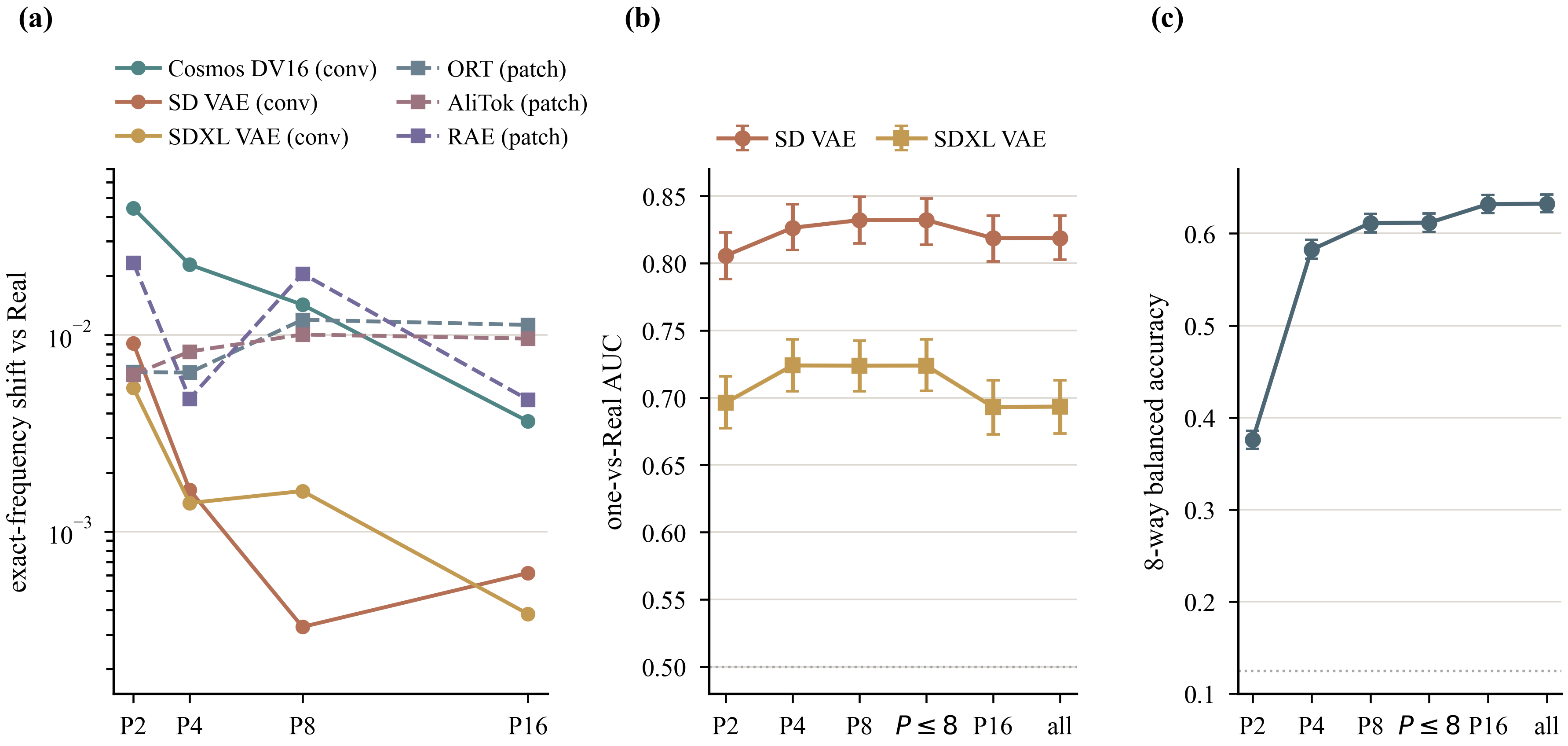
左:不同 decoder 的 exact-frequency shift。中:SD/SDXL 的 one-vs-Real AUC。右:八分类 balanced accuracy。虚线为对应任务的随机水平。
Cosmos 是直接反例:它同样使用 convolutional ResNet 与上采样,却在 P4–P16 上几乎可被完美检测。SD VAE 与 SDXL 也共享大类拓扑,但全尺度 AUC 分别为 0.819 与 0.693。因此,CNN 不是弱 fingerprint 的充分解释;具体 upsampling/filter response、训练目标、数据与权重同样关键。
NPR[10] 与 DIF[11] 都支持 CNN / upsampling architecture 可以提供可持续到输出图像的 artifact prior;EXP-11 并不否定这一先验。当前对照真正证明的是:architecture family alone 不能决定 fingerprint 的 amplitude、dominant period 或 single-image detectability。这些量仍与具体 operator、filters、objective、data 和 trained weights 共同变化。
| Fingerprint subset | 维数 | 8-way balanced accuracy | 主要作用 |
|---|---|---|---|
| P2 | 4 | 0.376 | pooling 强,但表达能力不足 |
| P4 | 16 | 0.582 | SDXL binary detection 最好 |
| P8 | 64 | 0.611 | SD VAE binary detection 已接近最好 |
| P16 | 256 | 0.632 | AliTok/ORT 等 patch-output decoder 的关键尺度 |
| P2+P4+P8+P16 | 340 | 0.632 | 最通用,但被 P16 维数主导 |
只使用小尺度能改善 SD-family 的 binary detection:SD VAE 从全尺度 0.819 提升到 P≤8 的 0.832,差值 95% CI 为 +0.004 到 +0.022;SDXL 从 0.693 提升到 P4 的 0.724,差值 CI 为 +0.014 到 +0.048。但小尺度不是通用替代:八分类 accuracy 会从 0.632 降到 P8 的 0.611,因为它丢掉了 AliTok/ORT 的 P16 信息。
机制上,小 P 的每个 phase cell 聚合更多像素位置:P8 每格 1,024 个位置,P16 每格只有 256 个。对 2× upsampling 累积出的弱周期响应,小尺度 pooling 提高了单图信噪比。另一方面,P16 在 340 维向量中独占 256 维,naive concatenation 容易稀释 subtle P2/P4/P8 signal。
08 / 证据边界
哪些已经成立,哪些仍只是机制一致的解释
- 01
已观测:decoder cohorts 具有可重复的多尺度 phase distribution
八组各 1,000 张图的 exact-frequency、distance、energy 与单图 OOF 结果相互一致。
- 02
强支持:AliTok decoder 造成 ORT 的 P16 fingerprint
生成与 oracle reconstruction 共享 decoder,并给出
ρ=0.996的 P16 pattern;PixelDiT control 很弱。 - 03
不支持:CNN 本身决定 fingerprint 强弱
Cosmos 是强可检测的 convolutional counterexample;SD/SDXL 共享拓扑却具有不同幅度。
- 04
不能声称:铺回像素的 field 是精确 RGB watermark
WP是总体 expected high-frequency bias field,单图 classifier 读取的是 noisy phase statistics。 - 05
采样限制:generated controls 没有完全 class-matched Real
Real/reconstruction subset 覆盖 650 classes;PixelDiT/ORT 为 1,000 classes 各一张。只读审计没有找到现成 one-per-class Real control。
- 06
尚未完成:固定其他因素的 decoder architecture 随机化
目前是 architecture-consistent evidence;还没有在相同 latent、loss、capacity 与 reconstruction quality 下只替换 upsampling/output head。
- 07
方法与 novelty 边界:嵌套周期共享固定 phase origin
P2/P4/P8/P16 是嵌套且 origin-aligned 的统计,不能称为四个独立 causal mechanisms。Phase-origin controls 与 fixed-latent decoder surgery 都尚未完成。
09 / 当前结论
Pixel generation 的优势之一,是不必把图像再经过一个会留下自身格点分布的 decoder
这组实验把最初的“patchify artifact”直觉推进成了可复现的分布证据:learned decoder 可以在 RGB 像素空间写入 architecture-specific、multiscale、部分可单图检测的高频 phase fingerprint。PixelDiT 并非与 Real 完全同分布,但它在当前指标上的 effect size 很小;ORT 与其 AliTok oracle reconstruction 则共享强且几乎一致的 P16 pattern。
现有证据支持“独立 latent decoder 是额外的像素分布偏移来源”,从原理上构成直接 pixel-space generation 的一个优势;它还不足以证明所有 latent generator 在感知质量、语义或 FID 上必然劣于 pixel generator。
下一步不需要训练新的生成器。首先加入显式 NPR / DIF baselines,并以 cyclic shift、random grid origin 与 phase-marginalized features 测量当前结果对 absolute phase 的依赖;再在现有 OOF features 上比较 naive concatenation、equal-block fusion 与 calibrated max-over-P,避免 P16 维数主导。完成这些 phase-origin controls 后,才使用固定 latent/input 的 decoder surgery,只改变 upsampling 或 output head,建立更严格的 architecture-level 因果对照。若现成数据允许,再补 one-per-class Real control 与未见过的 decoder family,检验跨数据与跨架构泛化。
10 / 引用
论文、官方模型与实验 provenance
- J. Deng et al., “ImageNet: A Large-Scale Hierarchical Image Database,” CVPR 2009, doi:10.1109/CVPR.2009.5206848.
- Y. Yu et al., “PixelDiT: Pixel Diffusion Transformers for Image Generation,” CVPR 2026, arXiv:2511.20645.
- ORT internal run provenance.
configs/ort/ort_alitok_xl.yaml; runort_xl_32gpus_400ep_alpha_1_beta_0; evaluationeval_scale15p5_pow2p5_internal1p5_temp1_seed5. ORT 不是本文声称的外部论文。 - P. Wu et al., “Towards Sequence Modeling Alignment between Tokenizer and Autoregressive Model” (AliTok), ICLR 2026, arXiv:2506.05289; official code and weights.
- NVIDIA et al., “Cosmos World Foundation Model Platform for Physical AI,” arXiv:2501.03575; official Cosmos-Tokenizer.
- stabilityai/sd-vae-ft-mse, official model card; architecture provenance: R. Rombach et al., “High-Resolution Image Synthesis with Latent Diffusion Models,” CVPR 2022, arXiv:2112.10752.
- D. Podell et al., “SDXL: Improving Latent Diffusion Models for High-Resolution Image Synthesis,” arXiv:2307.01952; official VAE artifact.
- B. Zheng et al., “Diffusion Transformers with Representation Autoencoders,” technical report, arXiv:2510.11690; official implementation. 本实验使用 DINOv2-B encoder with registers 与 ViT-XL n08 decoder。
- M. Oquab et al., “DINOv2: Learning Robust Visual Features without Supervision,” arXiv:2304.07193.
- C. Tan et al., “Rethinking the Up-Sampling Operations in CNN-based Generative Network for Generalizable Deepfake Detection,” CVPR 2024, arXiv:2312.10461.
- K. Sinitsa and O. Fried, “Deep Image Fingerprint: Towards Low Budget Synthetic Image Detection and Model Lineage Analysis,” WACV 2024, arXiv:2303.10762.
